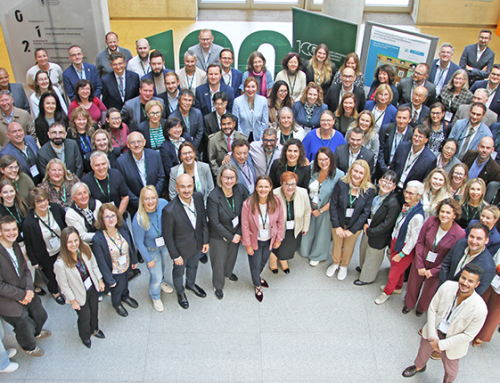
The 2026 AIB Canada Chapter Conference, hosted by the Beedie School of Business, Simon Fraser University, on May 22–23, 2026, brought together scholars, practitioners, and policymakers under the theme “Global Strategy, Sustainability, and Mobility in a Changing World Order.” The conference explored how firms, governments, and individuals are responding to geopolitical rivalry, sustainability challenges, and technological transformation.
Keynote Speakers and Opening Panel
The conference opened with a keynote address by Yuen Pau Woo, Senator for British Columbia, titled “Middle Power Strategies in an Era of Geopolitical Rivalry: Implications for Firms and International Business.” Senator Woo examined how middle powers such as Canada can navigate geopolitical competition and economic fragmentation through resilience-building, mutual assistance, hedging, and flexible coalition-building. His remarks interrogated the concept of “variable geometry” as an approach to navigating an uncertain and fragmented global order, and emphasized that international business is more relevant than ever—not only because firms must adapt to changing geopolitical realities, but because governments can learn from firms’ experience in managing uncertainty, complexity, and strategic flexibility.

The keynote was followed by a lively debate panel on the motion: “Firms Should Align with Their Home Government’s Geopolitical Priorities Rather Than Pursue Neutrality in the Emerging Global Order”. Speaking in favor were Yifan Wei and Peng Zhang (Simon Fraser University), while Sjoerd Beugelsdijk (University of South Carolina) and Liena Kano (University of Calgary) argued against. The discussion highlighted both the opportunities and challenges associated with geopolitical alignment. On the one hand, alignment with home-country priorities can provide firms with greater legitimacy, access to resources, and policy support. On the other hand, the evolving nature of the global order and the rapid pace of policy change make it difficult for firms to determine when, how, and with whom to align, creating significant risks.
Practitioner Engagement Initiative
A fireside chat with Jonathan Clarke, Public Sector Lead at Microsoft Canada, titled “Managing in a Fragmenting World: Strategy, Talent, and Technology,” explored how multinational technology firms respond to digital sovereignty agendas, the challenges of managing global talent and mobility, and the impact of artificial intelligence on productivity, innovation, and organizational practices.
Meet-the-Editors Initiative
The conference featured an Editors Panel titled “Where Should IB Research Go Next? New Research Frontiers and Lessons from Journal Editors”.

Bringing together editors and senior scholars from leading international business journals, the session provided participants with insights into underdeveloped research directions and publication strategies. Participants also engaged in small-group discussions reflecting on their experiences with publishing in top journals, creating a valuable forum for scholarly exchange.
Ethics in International Business Research
Another notable session was “A Deep Dive into AIB Publishing Ethics,” led by Professor Sjoerd Beugelsdijk. The session examined the AIB Journals Code of Ethics. Participants discussed emerging ethical questions around AI tools in research and publishing, highlighting the need for clear guidelines as AI becomes increasingly integrated into the research process.
PhD Student Initiatives
Dedicated programming for doctoral students remained a cornerstone of the conference. The PhD Workshop, led by Vanessa Hasse (Western University), focused on “Tacit Norms in Academia: How to Navigate Unspoken Expectations, Ambiguous Conflict, and Hidden Hierarchies.” Through candid discussions and shared experiences, participants explored the often-unwritten rules of academic life, including publishing, professional relationships, and navigating challenging situations.
Awards
Another highlight of the conference was the announcement of the Best Student Paper Award. The quality of submissions was exceptionally strong, reflecting the vibrancy of international business scholarship in Canada. The award was presented to Lifang Zhang and Anthony Goerzen (Queen’s University) for their paper, “Sustainability in Multi-tier Global Value Chains: A Configurational Approach on Structural Embeddedness and Governance Mechanism”.

The committee recognized the paper’s significant theoretical contribution and rigorous empirical design in addressing sustainability challenges in complex global value chains. Special recognition was also given to Khan Ashif Ur Rahman and Anthony Goerzen (Queen’s University) for their paper, “Cross-Sector Partnership in High-Risk Contexts: A Social Embeddedness Perspective,” which was a close runner-up.
Academic Program Highlights
Across multiple thematic sessions, the conference showcased research on responsible business and sustainability, regulatory complexity and geopolitical risk, global value chains, disruption management, and collaboration and inclusion in dynamic contexts. Many presentations examined how firms respond to geopolitical fragmentation, sustainability transitions, and technological change. Contributions from Canadian and international institutions highlighted AIB Canada’s role as a leading forum for advancing research at the intersection of international business and public policy.
This chapter conference report was composed by Jing Li and Mila Lazarova on behalf of the AIB Canada Chapter.